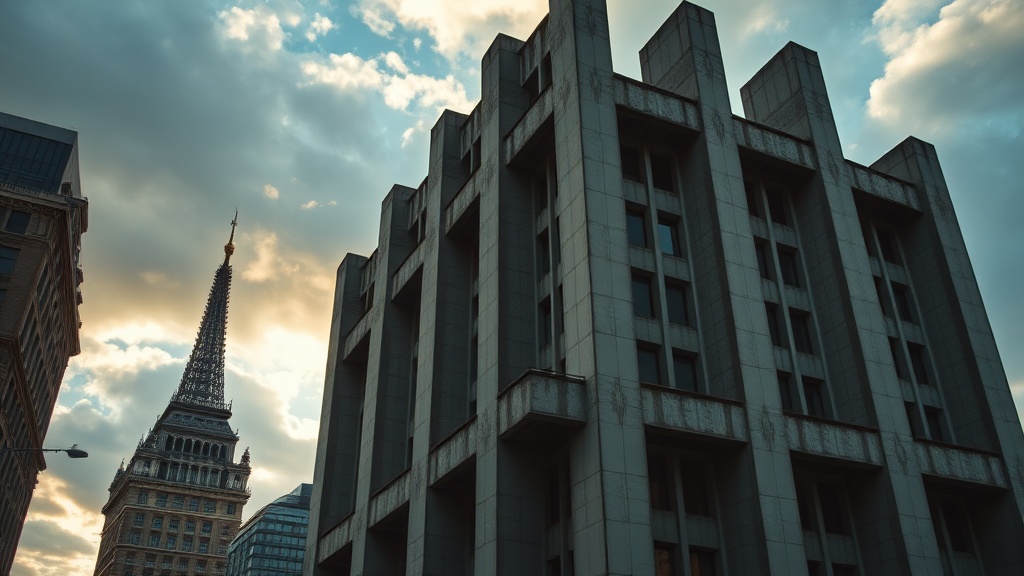
Concrete Giants: Finding the Soul of Brutalist Architecture in London and Paris

You're standing on the Southbank in London, the wind whipping off the Thames, and you're surrounded by what looks like a fortress of grey, textured stone. It's the National Theatre, a building that Prince Charles famously compared to a nuclear power station. But as you sit on those cold concrete steps, you realize it isn't just a pile of bricks—it’s a massive, breathable piece of art that invites you to hide in its shadows or look out from its tiered balconies. This post looks at the raw, often misunderstood world of Brutalist architecture in major European hubs and explains why these heavy giants are the most fascinating parts of a city walk. It matters because these buildings represent a bold, optimistic moment in history when architects believed they could build a better world out of simple, raw materials, and we're losing that history to the wrecking ball every day.
Why is Brutalism so controversial?
People love to hate concrete. It’s a gut reaction (often fueled by memories of grey school buildings or depressing housing estates) that views the material as cold and unfriendly. Brutalism, a name derived from the French term béton brut or "raw concrete," emerged after World War II when cities needed to rebuild quickly and cheaply. But it wasn't just about the cost. Architects like Chamberlin, Powell, and Bon wanted to create something honest. They didn't want to hide the structure behind fancy marble or decorative panels. They wanted you to see the textures left by the wooden boards used to mold the wet concrete—a process called board-marking. When you look closely at these walls, you aren't just looking at grey slabs; you're looking at the ghost of the wood grain, a permanent record of the building's birth.
Critics often say these buildings are aggressive, but proponents see them as protective. They're designed to be internal worlds. In a busy city like London, a Brutalist estate can feel like a sanctuary, blocking out the noise of the traffic and creating quiet, elevated walkways for residents. The controversy usually stems from how these buildings have been maintained. When concrete isn't cleaned or when the surrounding gardens are neglected, it can look grim. But when you see a well-kept example, the play of light and shadow across those jagged surfaces is something glass and steel buildings just can't replicate. It's a sculptural form of architecture that demands you take a side.
Where are the best Brutalist buildings in London?
If you want to see what this style looks like when it's allowed to succeed on a massive scale, the Barbican Centre is the place to start. It’s a sprawling complex of three high-rise towers, several lower blocks, a world-class arts center, and a conservatory—all tied together by a maze of high-level walkways. Walking through the Barbican is like stepping into a science fiction film from the 1970s. The architects used a bush-hammering technique on the concrete, which involves workers literally chipping away at the surface to reveal the aggregate underneath. This gives the building a rough, sparkling texture that changes color depending on the rain or sun. It's a city within a city, complete with its own lakes and private gardens that feel miles away from the chaos of the nearby financial district.
Not far from the Barbican, you’ll find the Trellick Tower, designed by Ernő Goldfinger (yes, the man who inspired the Bond villain's name). This 31-story tower is the peak of London’s social housing experiments. Its slim profile and separate service tower—connected by glass bridges—make it an icon of the skyline. For years, it was considered a dangerous eyesore, but today, it’s a Grade II* listed building where apartments sell for hundreds of thousands of pounds. People have come to appreciate the logic of its design and the incredible views it offers across West London. It’s a reminder that what we consider "ugly" is often just a matter of perspective and time.
How does Parisian concrete compare to the UK style?
While London’s Brutalism is often about texture and social housing, the French approach in the suburbs of Paris took things to a surreal, theatrical level. If you take the RER out to Noisy-le-Grand, you’ll encounter the Espaces d’Abraxas, designed by Ricardo Bofill. This isn't just a housing estate; it's a massive, postmodern take on a Greek amphitheater built entirely out of prefabricated concrete. It looks so much like a futuristic dystopia that it has been used as a filming location for movies like The Hunger Games. The scale is terrifying and beautiful all at once—a testament to the French ambition to create "palaces for the people."
These French "Grands Ensembles" were meant to solve the housing crisis with style. Another great stop is Les Choux de Créteil (The Cabbages), a series of round towers with distinct, petal-like balconies designed to give residents privacy and sunlight. These buildings weren't just about functional living; they were about creating a new visual language for the suburbs. They challenge the idea that concrete has to be boring or boxy. In Paris, concrete became a tool for creating grand, cinematic environments that feel like they belong on another planet. You can learn more about the history of these designs at the RIBA archives, which hold extensive records of these international movements.
How do you photograph concrete effectively?
Photography is one of the best ways to learn to appreciate these structures. Because Brutalist buildings are so focused on form and shadow, they make incredible subjects. The first tip is to avoid bright, midday sun. This might sound counterintuitive, but the harsh light can wash out the subtle textures of the concrete. Instead, aim for the "blue hour" just after sunset or an overcast day. Grey skies actually help emphasize the grey tones of the building, making it look more imposing and sculptural. Look for leading lines—the long, straight edges of balconies or walkways—and use them to draw the viewer’s eye into the frame.
Don't be afraid to get close. Some of the best Brutalist shots are detail oriented. Focus on the corners where two massive slabs meet, or the way moss and lichen have started to grow in the cracks of an older wall. This contrast between the "dead" concrete and "living" nature creates a powerful image. If you're using a phone, try turning on the "black and white" filter. Removing color forces you to focus on the contrast and the geometry of the architecture, which is exactly what the architects intended. You'll start to see the rhythm of the windows and the repeating patterns of the supports in a way that you don't notice when you're just walking past.
Is the concrete era finally coming to an end?
We are seeing a strange shift in how we treat these buildings. For decades, the default answer was to tear them down and replace them with glass boxes. But today, architects are realizing that the "greyest" thing you can do is demolish a building that’s already standing. The carbon footprint of all that concrete is already spent; keeping it and repurposing it is much better for the planet than building something new. Look at the National Theatre in London, which has undergone major renovations to improve its energy efficiency while keeping its iconic facade. It’s a sign that we’re finally learning to live with our concrete heritage rather than trying to erase it.
Visiting these sites isn't just about looking at old buildings; it's about understanding a specific kind of urban ambition. These architects weren't trying to build something "pretty" in the traditional sense. They were trying to build something that would last, something that felt as permanent as a mountain. Whether you find them beautiful or brutal, you can't deny that they have a presence. They don't hide. They don't apologize. In a world of flimsy, temporary things, there’s something deeply satisfying about a building that’s built to survive a century without breaking a sweat. So, the next time you see a massive concrete wall, don't just walk past it. Put your hand on it, feel the grain, and think about the people who thought this was the future.