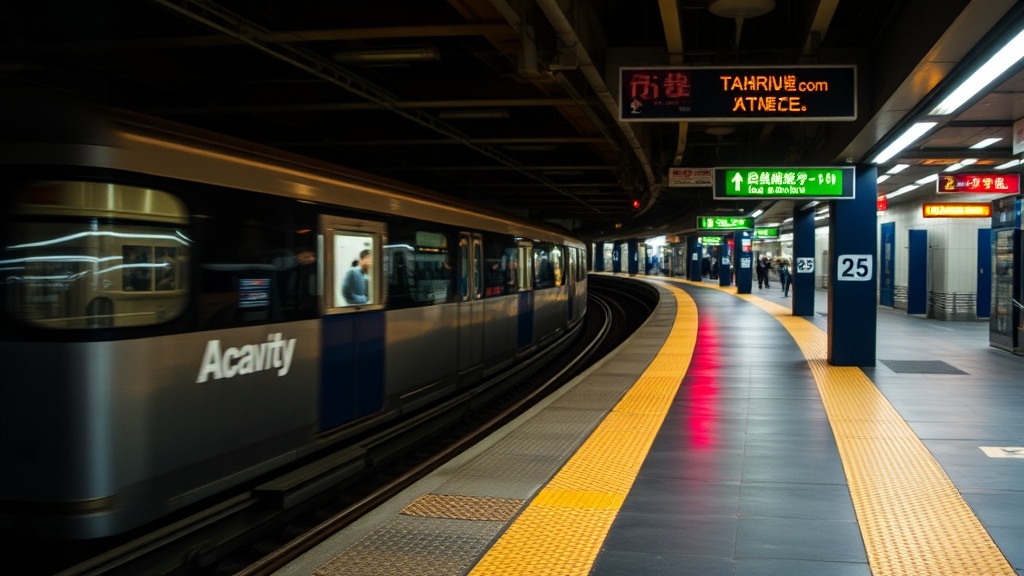
Where Do the Tracks Lead? Exploring Cities Through Their Public Transit Lines

You step onto a rumbling tram in Lisbon — the yellow carriage lurches forward, and suddenly you're winding through neighborhoods no guidebook bothered to mention. The woman beside you carries a bouquet of flowers from a shop three stops ahead. An elderly man exits at a station you've never heard of, and you follow him on instinct. This is how cities reveal themselves: not through curated tours, but through the arteries that locals use every day. Public transit isn't just a way to get from the airport to your hotel — it's a lens for seeing how a city actually breathes, where people live, work, and gather when no one's watching.
Why Take the Bus When You Could Walk?
Walking gives you texture — the smell of a bakery, the sound of street musicians, the crack of cobblestone underfoot. But public transit stretches your range. You can't walk across Mexico City in a day (believe me, I've tried). The metro there carries five million people daily, and each line tells a different story about who lives where and why. Line 12 — the Golden Line — cuts through working-class neighborhoods where vendors sell tamales at station entrances and murals tell histories the textbooks forgot. The Blue Line surfs aboveground through the southern reaches, past canals where locals still farm on floating gardens called chinampas.
Transit exposes economic geography. In London, the Tube map shows you where housing got expensive decades ago — follow the Central Line east from Notting Hill and watch the demographics shift through the windows. In Tokyo, the Yamanote Line loops through the city's gravitational centers: Shinjuku's chaos, Shibuya's youth culture, Ueno's older rhythms. You could ride it in an hour, or you could spend a week stepping off at random stations and finding temples wedged between office towers, izakayas under railway arches, neighborhoods that feel like villages someone forgot to pave over.
The question isn't whether to use public transit — it's how to use it as more than mere transport. Tourists plot routes from A to B and miss everything between. Locals know the between is where life happens.
What Can You Learn from Riding the Wrong Line?
Mistakes help. Get on the wrong tram in Budapest — say, the 4/6 instead of the 47/49 — and you'll find yourself crossing the Danube into Buda's hills instead of staying in Pest's flat grid. That's not a detour; that's discovery. The 4/6 line runs along the Grand Boulevard, past the New York Cafe (overrated and expensive) and into neighborhoods where university students pack into basement bars that don't appear on English-language maps.
In Buenos Aires, the Subte's Line A still runs on wooden cars imported from Belgium a century ago. Take it to the end at Plaza de Mayo and you're at Argentina's political heart — but stay on through the central stations and watch the neighborhoods change from government buildings to immigrant communities. The Line B spur to Los Incas drops you at a shopping mall built to look like an ancient temple, which sounds tacky until you realize how deeply Peronism and indigenous identity intertwine in Argentine politics.
Pay attention to who boards where. Morning rush hour reveals commuting patterns — suits with laptops cluster on lines heading to financial districts; construction workers with lunch pails fill routes to industrial zones. Evening shows you where people play — trains toward beach suburbs swell with surfboards and towels; lines to nightlife districts carry dressed-up crowds and the electric anticipation of the night ahead.
Transit also teaches you about inequality. In São Paulo, the Metro connects wealthy districts while vast peripheral zones rely on buses that crawl through traffic for hours. In Johannesburg, the Gautrain serves the airport and affluent northern suburbs, but the minibuses — those rattling, unregulated taxis — carry the real stories of how most people actually move. If you want to understand a city, ride what the majority rides. Comfort isn't the point.
How Do You Read a Transit Map Like a Local?
Transit maps are abstractions — they smooth out geography to emphasize connections. The London Tube map, designed by Harry Beck in 1933, revolutionized wayfinding by treating the network as a circuit diagram rather than a geographic map. This matters because it shapes how you perceive distance. Two stations that look adjacent on the map might be miles apart on the surface; two that seem far apart could be a short walk.
Learn the difference between express and local services. In New York, the same color line might skip every other station — the difference between a 20-minute trip and an hour. In Paris, the RER commuter trains share stations with the Metro but shoot out to the suburbs at speeds that make you realize how small the central arrondissements really are. Take RER B to Denfert-Rochereau and you're at the catacombs; stay on to Robinson and you're in a forest where Parisians walk their dogs and forget they're in a city of millions.
Look for transfer stations — those points where multiple lines cross. These are often the city's historical hubs, places where different eras of development collided. In Berlin, Alexanderplatz connects U-Bahn, S-Bahn, trams, and buses — a socialist-era plaza surrounded by pre-war reconstruction and post-reunification commerce. In Hong Kong, Central Station funnels commuters from the Mid-Levels escalators, the Star Ferry, and the Airport Express into a subterranean maze of shops and passageways that feels like the entire city compressed into one building.
Transit maps also encode class and history. The Moscow Metro stations are palaces — marble, chandeliers, mosaics of triumphant workers — because Stalin intended them as propaganda of Soviet achievement. Compare that to the brutal functionality of New York's subway, built by competing private companies and unified only by need. Or the spotless efficiency of Tokyo's system, where workers called oshiya once pushed passengers into packed cars, and where trains apologize for being 20 seconds late.
Which Cities Reward the Transit-Curious Traveler?
Some cities make this easy. Vienna's trams run in circles around the Ringstrasse, past the Opera, Parliament, and palaces — a tourist line that locals actually use. You can ride the entire route in under an hour, hopping off when something catches your eye: a side street, a park, a cafe full of newspapers and retirees arguing about politics.
Prague's tram 22 follows a scenic route through the castle district, but the real discovery comes from riding it in the opposite direction — south through neighborhoods where old villas crumble behind overgrown gardens, where the city feels like it did before the tourists arrived. The same tram continues to the suburbs, past paneláks (those concrete apartment blocks from the Communist era) that house most of Prague's actual population.
Istanbul's ferries trump any land-based transit for pure atmosphere. The routes across the Bosphorus — Eminönü to Kadıköy, Beşiktaş to Üsküdar — give you minarets and seagulls and tea served in tulip-shaped glasses. The vapur boats have been running for centuries, and they carry commuters, students, and fishermen alongside tourists who figured out that the best views of the city come from the water.
In smaller cities, buses become the adventure. Lisbon's yellow trabs get the Instagram love, but the real exploration happens on the hillside elevators — outdoor lifts that connect steep neighborhoods. The Elevador da Bica drops you in a street of fish restaurants and tiled buildings; the Elevador de Santa Justa delivers tourists to a viewing platform, but locals use it as a shortcut between Baixa and the Bairro Alto.
How Do You Start Your Own Transit Exploration?
Pick a line that crosses the city rather than circling the center. Ride it to the end. Get off and walk for an hour — not toward a destination, but in expanding circles from the station. Notice what's near the exits: churches, schools, markets, government buildings. These anchor institutions reveal what the neighborhood values.
Time matters. Early morning shows you delivery routes and opening rituals — the bakeries firing up, the street sweepers finishing their rounds, the commuters queueing for coffee at the same stand they've used for years. Midday brings parents with children, elderly shoppers, the rhythms of people who don't work office hours. Evening rush is chaos and compression; late evening is when cities soften, when workers head home and others head out, when the transit itself becomes a social space.
Talk to people — or at least observe without the distraction of headphones. In many cities, transit is where strangers coexist in close proximity without acknowledging each other, but breaks in that code happen: a shared complaint about delays, directions offered without asking, commentary on the weather that serves as permission to be briefly human together. These moments — fleeting, unscripted — are the texture of urban life that no walking tour can manufacture.
Carry a notebook. Not for recording monuments or museums, but for the details: the name of a shop, the color of a door, the route number you want to try tomorrow. Cities reveal themselves slowly, and transit gives you the framework to collect these revelations without the pressure of constant navigation.
The goal isn't efficiency. The goal is to see the city as its residents do — as a network of possibilities, connections, and neighborhoods that matter to the people who call them home. Your ticket isn't just for transport; it's admission to a continuous, unfolding documentary of urban life. Use it well.